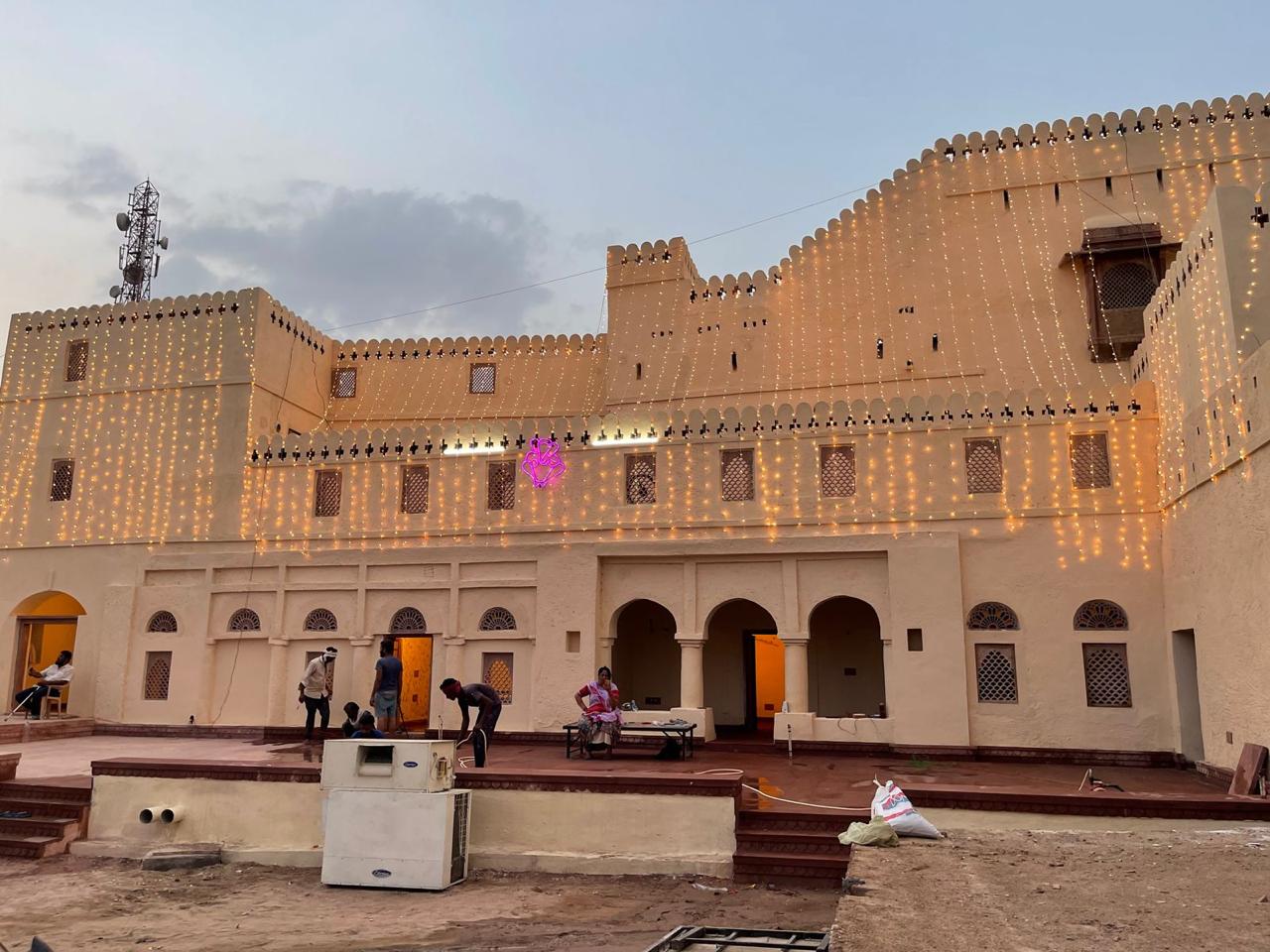
The Pugal fort is quite magnificent in its site. It is situated on a solid sand dune having a height of nearly 100 feet from the ground. It is constructed in lime & brick. The construction of the fort has been so solid that even after passing of nearly 1200 years , the fort is standing firmly on it . Some very significant ruining has taken place in last ten to fifteen years due to heavy rains as we know that rain water seeps through lime work very easily. It goes without saying that in 9th century only that material was used which was not suitable for rain. Pugal is situated in heart of Thar desert.
The Fort is constructed in three stories, two above ground and one below the ground; there are nearly 30 rooms built all together. Some architecture of this fort also belongs to sultanate period. It was Feroz Tughlaq who was ruling in Delhi when fort was constructed[1380 AD]. The characteristics of the architecture of Delhi sultanate are very much visible. Like meharab in triangle shape, simple Jali work in windows, small bricks, use of lime which was available in the local area etc.
Mr Hermann Goetz in his book ‘Art and Architecture of Bikaner State’ wrote (page 68) “The present fort at Pugal which overlooks a bazaar and some primitive huts, is, like Bhatner, a mound surrounded by strong fortifications mainly of the 16th century Mughal type, the lower sections constructed in sun-dried, the upper ones in burnt brick. The gateway and the long vaulted passage leading to the exterior palace court are in the provincial Mughal style of the middle 17th century”.